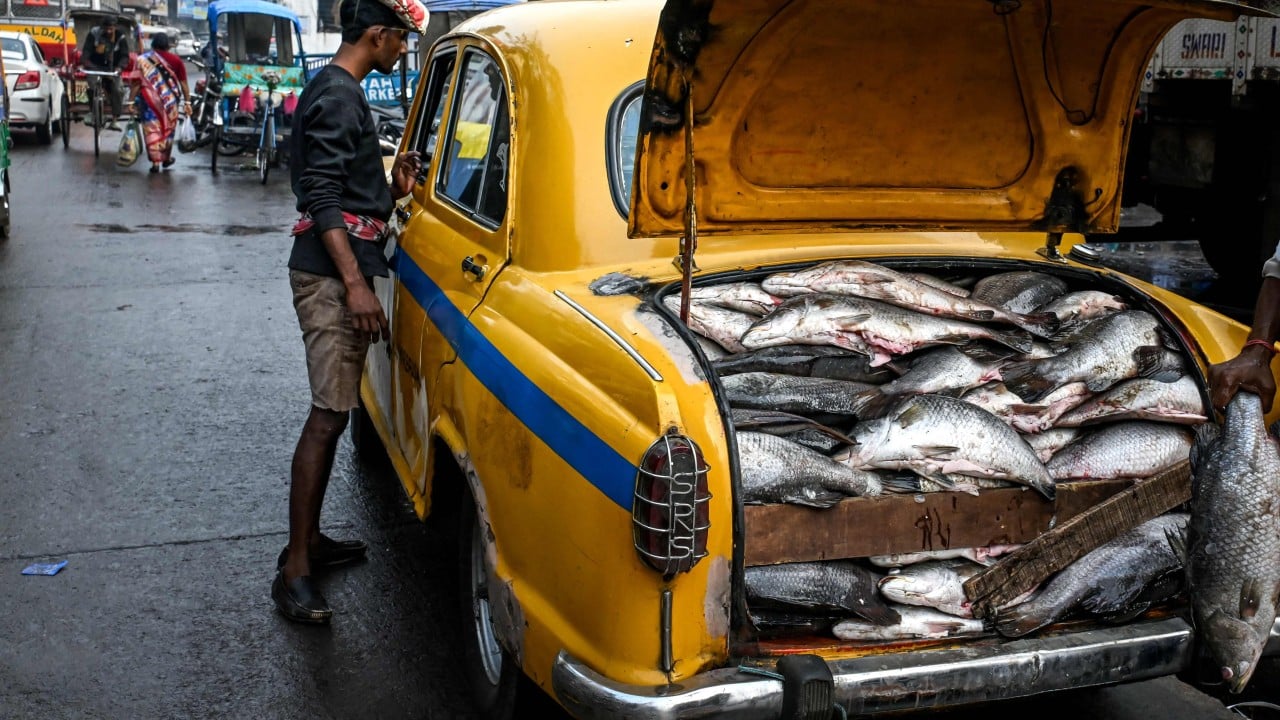
The scent of mustard oil hitting a smoking hot pan is the unofficial anthem of West Bengal. It is a sharp, pungent aroma that carries the weight of centuries. In a small kitchen in Kolkata, Anjali Mitra slides a piece of silver-scaled Hilsa into that oil. The hiss is instantaneous. For Anjali, this isn't just lunch. It is an act of identity. But lately, the simple act of frying fish has begun to feel like a political statement.
In the winding alleys and sprawling delta lands of West Bengal, the dinner table has become a frontline. For decades, the state prided itself on a syncretic culture where the Maach-Bhaat (fish and rice) lifestyle was the great equalizer. It didn't matter if you were a professor or a rickshaw puller; the love for a bony, flavorful carp was the common thread. Now, that thread is being pulled by outside forces, threatening to unravel the very fabric of the region.
The shift is subtle until it isn't. It starts with a whisper in a political rally or a pointed comment on a WhatsApp group. The "vegetarianization" of Indian politics has arrived at the borders of a state that defines itself by its appetite for river silt and silver scales.
The Geography of a Grudge
To understand why a piece of fish matters, you have to understand the soil. West Bengal is a land defined by water. The Ganges, the Brahmaputra, and a thousand smaller veins of water crisscross this landscape. Meat and fish aren't luxuries here. They are staples provided by the geography itself.
In many parts of Northern and Western India, vegetarianism is often tied to notions of "purity" and social hierarchy. But in Bengal, the Brahmin priest and the daily laborer often share a preference for the same fish curry. When political narratives from the "cow belt" began to seep into the local discourse, they brought a foreign set of values. They brought the idea that what you eat determines your moral standing.
Imagine a young man named Rahul. He grew up in a household where Sunday mutton curry was a sacred ritual. Now, he moves in circles where "non-veg" is increasingly framed as "tamasic"—dark, heavy, and spiritually inferior. He feels a new, creeping shame. This isn't just about nutrition. It is about a soft power struggle for the soul of a people.
The statistics tell a stark story. Over 98% of West Bengal’s population identifies as non-vegetarian. To suggest that vegetarianism is the national ideal is to tell nearly every single person in the state that their lifestyle is fundamentally "un-Indian."
The Weaponization of the Kitchen
Politics is rarely about the big things. It is about the small, intimate things that make us who we are. During the recent election cycles, the "fish vs. vegetarian" debate wasn't just background noise. It was a strategic wedge.
Opposing political factions used food as a shorthand for "us" versus "them." On one side, there was the projection of a muscular, pan-Indian identity that favors a standardized, vegetarian diet. On the other, a fierce, almost reactionary defense of Bengali "exceptionalism."
But the stakes are higher than just a choice of protein. When a political movement suggests that certain foods are "pure" and others are "tainted," they are creating a hierarchy of citizenship. They are saying that to be a "good" citizen, you must eat like a certain group of people. In Bengal, this feels like a cultural invasion. It feels like someone walking into your home and telling you your grandmother's recipes are a sin.
The tension manifests in the local para (neighborhood) shops. Shopkeepers who once focused on the price of onions now find themselves debating the ethics of egg consumption. The "culture war" has moved from the television screens to the frying pans.
The Economics of Identity
Food is never just about culture; it is also about the wallet. The push for a more "sattvic" or vegetarian lifestyle has real-world economic consequences for the millions of fishermen in the Sunderbans and the poultry farmers in rural districts.
Consider the plight of Biplab, a fisherman who has spent thirty years navigating the unpredictable waters of the Hooghly. His livelihood depends on the state's insatiable demand for fish. If the social climate shifts—if "fish-eating" becomes a stigmatized activity associated with a certain political or religious leaning—Biplab’s entire world collapses.
There is a cruel irony here. The very people who claim to want to "unify" the country are often the ones creating the deepest rifts by attacking the economic foundations of regional life. By framing food choices as a moral binary, they aren't just changing diets. They are threatening the survival of those who provide the food.
The Invisible Stakes
Why does this matter to someone outside of Bengal? Because West Bengal is a laboratory for the rest of the world. It is a case study in what happens when a globalized, standardized ideology meets a deeply rooted, local culture.
If the "standardizers" win, we lose more than just a few fish recipes. We lose the diversity that makes a nation resilient. We lose the idea that there are multiple ways to be "good," "patriotic," or "pure."
The battle isn't really about fish. It's about autonomy. It's about the right to live a life that is congruent with your history and your environment. When we allow food to be weaponized, we give up a piece of our private lives to the state and the mob.
The Fragile Peace of the Plate
Back in the kitchen, Anjali Mitra serves the fish. Her grandchildren sit at the table. They are part of a generation that is being bombarded by different versions of what it means to be Indian. One version tells them to look toward a homogenized future where everyone eats the same, speaks the same, and prays the same. The other version is the one on their plate—messy, bony, pungent, and deeply local.
The dinner table is a sanctuary, but even sanctuaries have windows. And through those windows, the shouting of the rallies can still be heard. The push for vegetarianism in West Bengal isn't a movement toward health or compassion. It is a movement toward conformity.
The real test of a democracy isn't how it handles its majority, but how it protects the nuances of its regions. In the narrow lanes of Kolkata, that protection looks like a bowl of spicy fish broth. It looks like the refusal to let a politician decide what belongs in your stomach.
There is a quiet defiance in the way a Bengali de-bones a fish. It requires patience, precision, and a total focus on the task at hand. You cannot rush it. You cannot standardize it. It is an individual act of labor and love. As long as that smell of mustard oil and frying fish continues to rise from the windows of the city, the attempt to flatten the culture will remain unfinished. The plate remains a protest. The meal remains a memory of who they were before they were told who they ought to be.