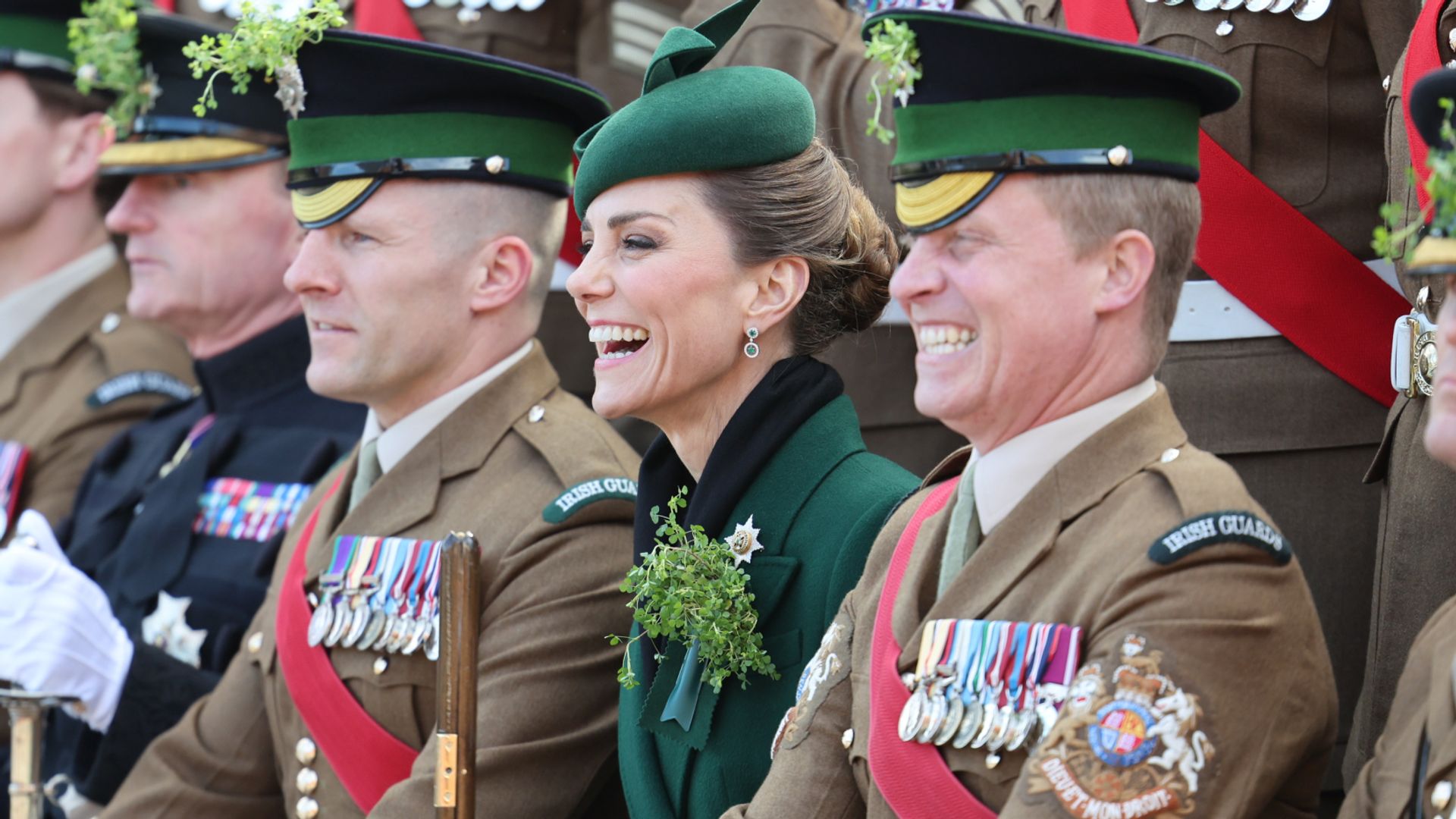
The sight of the Princess of Wales handing out sprigs of shamrock to the Irish Guards is a carefully calibrated exercise in soft power. While the surface narrative focuses on the heritage of the St. Patrick’s Day parade at Mons Barracks, the underlying reality involves a complex transition of military patronage and a relentless effort to modernize the image of the monarchy. This annual tradition is no longer just a photo opportunity. It is a strategic deployment of the Royal Family’s most effective asset to maintain relevance within the British Armed Forces during a period of significant structural change.
Catherine’s role as Colonel of the Irish Guards, a position she took over from Prince William in late 2022, represents a shift in how the palace manages its military associations. By placing a high-profile female royal at the head of a frontline infantry regiment, the institution is signaling a break from the rigid, male-dominated tradition of the past. It isn't just about the green coat or the salute. It is about the optics of a 21st-century military that seeks to appear inclusive while grappling with recruitment crises and a shifting geopolitical focus.
The Strategic Pivot of Military Patronage
The transition of the Colonelcy was not a random administrative shuffle. When King Charles III redistributed the military appointments formerly held by the Duke of York and those previously managed by the Prince of Wales, he was looking to consolidate the "working" core of the family. The Irish Guards, known affectionately as "The Micks," are one of the most prestigious units in the British Army. Entrusting them to Catherine was a calculated move to ensure the regiment remained in the global spotlight.
Military patronage serves as the connective tissue between the sovereign and the boots on the ground. For the Irish Guards, having the Princess as their figurehead provides a level of media visibility that no other colonel could offer. This visibility is a form of currency. In an era where defense budgets are under constant scrutiny and the utility of the Guards' ceremonial duties is often questioned by the public, the "Kate Effect" provides a protective layer of popularity.
However, this role requires more than just showing up once a year in Aldershot. Behind the scenes, the Princess is expected to understand the operational readiness of the battalion. The Irish Guards have been heavily involved in training Ukrainian forces and maintaining a presence in security operations across Africa and the Middle East. When the shamrock is pinned to a tunic, it isn't just a nod to Saint Patrick. It is a recognition of the grit and specialized skill of a unit that spends more time in the mud than on the parade square.
Breaking the Traditional Mold
Historically, the Colonel of the Irish Guards was a senior male royal or a retired general. The departure from this norm was met with some skepticism in the more traditional corners of the military establishment. Yet, the rank-and-file response has been notably different. Soldiers today are more concerned with advocacy and genuine interest than with the gender of their patron.
Catherine has spent the last year deepening her "green" credentials. She has moved beyond the superficiality of the parade ground by participating in cold-weather survival training and battlefield casualty drills. This hands-on approach is designed to counter the criticism that royal military titles are merely "honorary" or "ornamental." By getting her hands dirty—quite literally—she builds a rapport with the troops that a purely ceremonial figure could never achieve.
The challenge lies in balancing the glamour required for public consumption with the gravity required by the soldiers. A parade is a performance. The precision of the march, the grooming of Seamus the Irish Wolfhound (the regimental mascot), and the exact placement of the shamrock are all part of a visual language that communicates stability. In a world that feels increasingly volatile, the monarchy uses these rituals to project a sense of unchanging British identity, even as the substance of that identity evolves.
The Cost of the Crown in the Barracks
Maintaining these traditions is not without expense. The logistics of a royal visit to a military base involve months of planning, security sweeps, and rehearsals. For the Irish Guards, the St. Patrick’s Day parade is the climax of their ceremonial calendar, but it also represents a significant diversion of man-hours. Critics often point to these events as evidence of a military that is too focused on its past.
The counter-argument, and the one the palace relies upon, is that these traditions are essential for morale and "espirit de corps." The British Army is built on the regimental system, where history and lineage are used to bind soldiers together. The Royal Family acts as the ultimate custodian of that history. When the Princess of Wales interacts with the families of the guardsmen, she is reinforcing a community structure that supports the soldier during deployment.
We should also look at the recruitment data. The British Army has struggled to meet its targets for years. High-profile events like the St. Patrick’s Day parade serve as a powerful recruitment tool. They present a version of military life that is disciplined, respected, and intrinsically linked to the national story. Whether this translates into long-term retention is another matter entirely, but for a day, the Irish Guards are the most famous soldiers in the world.
The Evolution of the Royal Wardrobe as a Tool
In the world of high-stakes diplomacy and public relations, clothing is never just clothing. Catherine’s choice of attire for the Irish Guards’ celebrations is a masterclass in symbolic communication. Over the years, we have seen a transition from standard "royal green" to more functional, military-inspired tailoring. This reflects her shift from a supportive spouse to a commander in her own right.
The gold shamrock brooch she wears is a piece of history itself. It is a royal heirloom, often loaned to the women of the family who have a connection to the regiment. By wearing it, she is literally pinning the weight of the institution’s past to her chest. It serves as a reminder that while she is a modernizing force, she is still operating within the strictures of a thousand-year-old monarchy.
The Irish Connection and Political Sensitivity
The relationship between the British Monarchy and Irish identity has always been a minefield. The Irish Guards were formed in 1900 by Queen Victoria to honor the Irishmen who fought in the Boer War. Today, the regiment recruits from both the Republic of Ireland and Northern Ireland, as well as from the Irish diaspora in the UK.
This makes the St. Patrick’s Day parade a delicate balancing act. The Princess must celebrate "Irishness" within a strictly British military context without veering into political territory. The focus is kept strictly on the soldiers and their service, using the shamrock as a unifying symbol that transcends the complex history of the two islands. It is an exercise in cultural diplomacy performed in the middle of a parade ground.
The presence of the Regimental Mascot, the aforementioned Irish Wolfhound, is a vital part of this. It softens the military image and provides a relatable point of contact for the public. Behind the "cute" photos of the Princess petting the dog, however, is a rigid protocol. Every movement is scripted. Every interaction is timed. The goal is a flawless execution that leaves no room for controversy or misinterpretation.
The Pressure of the Public Eye
The intensity of the scrutiny on Catherine has reached unprecedented levels. Every gesture, every look shared with the troops, and even her physical health are dissected by a global audience. This pressure is the hidden tax of the role. For the Irish Guards, the Princess isn't just a boss; she is a symbol of the nation's expectations.
This scrutiny can be a double-edged sword. While it brings attention to the regiment, it also means that any slip-up or perceived lack of interest would be amplified a thousandfold. The Princess has navigated this by adopting a persona of "cheerful stoicism." It is a modern iteration of the "never complain, never explain" mantra, updated for a social media age where silence is often filled with speculation.
The reality of being the Colonel of the Irish Guards is that the work continues long after the shamrocks have wilted. It involves visiting injured soldiers, supporting the families of the fallen, and acting as a constant point of stability for a unit that is frequently in harm's way. The parade is the only part the public sees, but the legitimacy of her title is earned in the private moments between the ceremonies.
The Changing Face of the Household Division
The Irish Guards are part of the Household Division, the elite group of regiments tasked with protecting the Sovereign. This division is currently undergoing a period of intense self-reflection. Issues regarding diversity, conduct, and the relevance of "guardsmanship" in an era of drone warfare are being debated in the halls of the Ministry of Defence.
Catherine’s leadership—even if largely symbolic—comes at a time when the division needs to prove it is not a relic of the Victorian era. Her presence at the St. Patrick’s Day parade is a visual argument for the division's continued importance. She represents the "New Monarchy": leaner, more professional, and more attuned to public sentiment.
The question remains whether this branding is enough to sustain the institution in the long term. The Royal Family is currently operating with a reduced roster of working members. This puts an immense burden on the Princess of Wales to be everywhere at once. The Irish Guards are just one of many responsibilities, yet they require a specific type of dedication that cannot be faked.
Beyond the Green Coat
To understand the true significance of the St. Patrick’s Day parade, one must look past the spectacle. It is a demonstration of the enduring contract between the Crown and the military. The Princess of Wales is not just handing out plants; she is renewing a vow of mutual support.
As the military landscape shifts toward high-tech, remote operations, the value of these physical, high-visibility rituals actually increases. They provide a human face to an increasingly automated sector of the state. Catherine’s role is to ensure that face remains one that the public trusts and the soldiers respect.
The weight of the shamrock is heavier than it looks. It carries the history of a regiment, the expectations of a country, and the survival of a royal brand that must constantly justify its own existence. The Princess knows this. Every step on that parade ground is a move in a much larger game of cultural and institutional chess.
The next time you see the photos from Mons Barracks, look at the eyes of the soldiers. They aren't looking at a celebrity. They are looking at the person who represents the very top of their chain of command, a woman who has successfully occupied a space once reserved for the grizzled veterans of a different age. That transition is the real story, and it is far from over.